
Choosing the right retractable CIP Nozzle: how to select the best item?
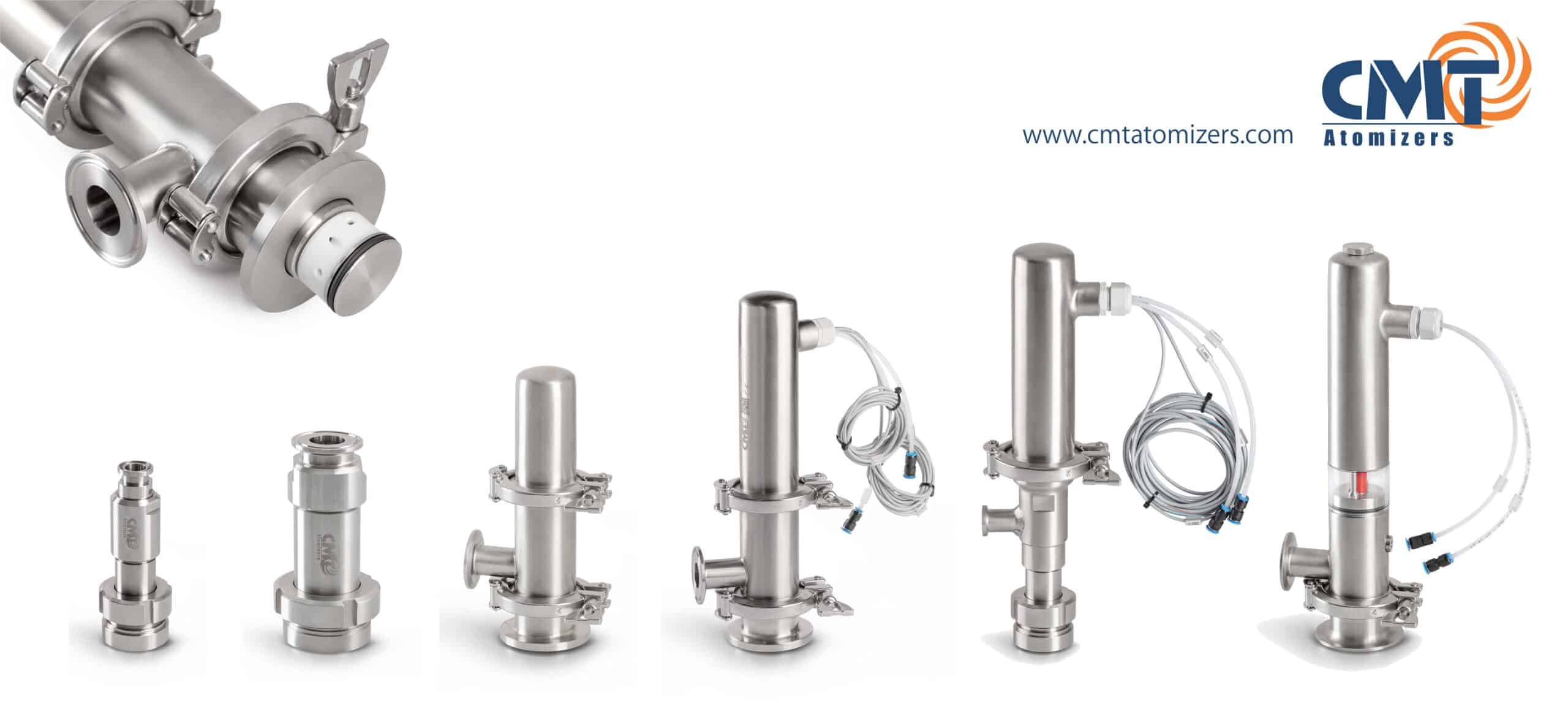
In industrial processing, repeatable cleaning is essential for product quality, process reliability, and regulatory compliance. Cleaning in Place (CIP) removes residues from vessels, ducts, and process equipment without dismantling, reducing downtime and contamination risks — especially in food and beverage, dairy, pharmaceuticals, and chemicals.
Retractable CIP nozzles provide a flush, production-safe alternative to static spray devices. Welded into the vessel wall or duct, they stay flush during production and extend only during the cleaning cycle, activating a rotating spray head. Because the nozzle retracts and the head rotates in a controlled way, the system can deliver more uniform coverage and better soil removal — particularly with strongly adhering residues or where repeatability is required by quality systems.
Two main configurations are used to match different operating constraints: high-flow (HF) and low-flow (LF) retractable CIP nozzles. In both cases, the cleaning media acts as a lubricant, reducing the need for external lubrication and supporting reliable operation in sanitary environments. While the operating principle is the same, flow rate and spray dynamics affect achievable reach, impact energy distribution, and water and detergent consumption.
High-flow CIP nozzles are designed for demanding applications where cleaning performance and reach take priority. By operating at higher flow rates, HF systems generate strong kinetic energy at the point of impact while the rotating head maintains consistent coverage across large internal surfaces.
In common configurations, HF retractable nozzles reach an active impact radius (effective cleaning force) of ~2.5 meters and a wetting radius (surface coverage) up to ~4.5 meters.
They are suited to large tanks, reactors, and process vessels with complex geometries or heavy contamination — common in large-scale:
This added reach can make cleaning results more consistent without relying solely on longer cycle times.
From an integration standpoint, HF solutions are built around a flush, retractable sanitary design, commonly manufactured in AISI 316L stainless steel. Actuation can be achieved through liquid pressure (ST) or pneumatic actuation (PA), depending on the plant’s utilities and automation preferences. Where required, ATEX-certified versions (3G/3D) are available. Stroke length, inlet connection, and other design parameters can also be customized to match vessel layout and installation constraints.
Low-flow CIP nozzles are engineered to deliver effective cleaning while reducing water and detergent consumption. Instead of relying on volume, LF designs focus on spray efficiency and nozzle geometry to maintain sufficient impact energy at lower operational flow rates — an approach often aligned with sustainability targets and operating cost control.
LF retractable nozzles provide an active impact radius of ~1.8 meters and a wetting radius up to ~3.5 meters. They are well suited for small to medium vessels, shorter spray distances, and applications where utilities are limited or frequent cleaning cycles make consumption a key variable — often the case in:
Where running multiple products or requiring high cleaning frequency are necessary.
LF solutions share the same flush installation concept: the nozzle is welded directly into the vessel or duct and remains flush during production. Construction is generally AISI 316L stainless steel, with ST (liquid pressure) or PA (pneumatic) actuation options available. ATEX-certified versions can be specified for hazardous environments, supporting compliance without forcing compromises on cleaning strategy.
Choosing the right retractable CIP nozzle starts with real constraints, not theory. A practical evaluation considers vessel size and geometry first:
The type of residue matters just as much: products that dry quickly, form films, or create stubborn deposits typically require higher mechanical energy, whereas more easily removable residues may not justify high-flow utility use.
Finally, real installations introduce constraints that standard configurations do not always cover. This is where customized CIP nozzle solutions become relevant: stroke length, spray pattern, actuation method, and installation geometry can be adapted to align cleaning performance with the vessel layout, available utilities, and process
objectives — without compromising cleanability requirements.
For application-specific guidance, reach out via our CMT contact page. Our team can help you choose the most suitable option for your process!
