
ATEX Certification for atomizers: Zone 20, Zone 21 and Zone 22
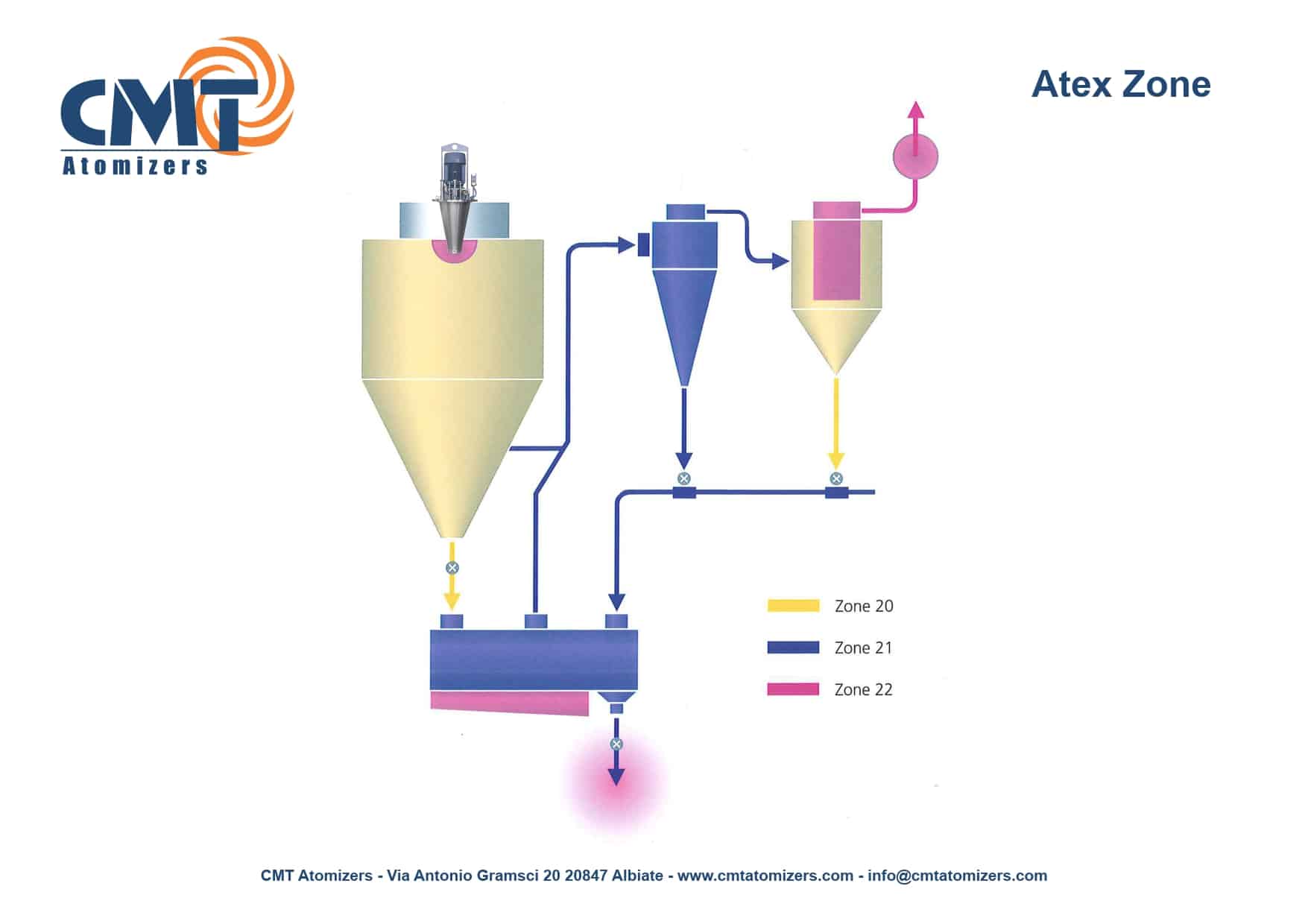
Spray drying processes often involve fine combustible powders which, under certain conditions, can create an explosive atmosphere. In these applications, ATEX classification is not simply a compliance detail: it is one of the factors that determine how the atomizer and its associated components should be specified.
There is therefore no universal ATEX atomizer. The right solution depends on the classified area, the process itself and the conditions in which the equipment will operate. CMT can configure and clarify its rotary atomizers for applications in Zones 20, 21 and 22, adapting the equipment to the requirements of each installation.
INDEX
For combustible dust, hazardous areas are divided into three categories according to how often an explosive atmosphere is expected to occur and how long it is likely to remain present: ATEX Zone 20, ATEX Zone 21 and ATEX Zone 22.
Dust zone classification is a key element of explosion risk assessment in spray drying applications, helping determine the requirements for equipment and protective measures. However, the zone classification alone does not define the complete equipment specification. Other factors, including the properties of the product being processed, operating temperatures, atomizer speed and installation conditions, must also be considered when assessing the suitability of the equipment.
ATEX Zone 20 applies where a cloud of combustible dust is present continuously, for long periods or frequently during normal operation.
Of the three dust zones, Zone 20 generally requires the highest level of equipment protection, making a thorough assessment of operating conditions and equipment specifications essential.
ATEX Zone 21 covers areas where an explosive dust atmosphere is likely to occur occasionally during normal operation. Exposure is less frequent than in Zone 20, but it remains an expected process condition and must be taken into account when selecting the equipment.
ATEX Zone 22 applies where an explosive dust atmosphere is unlikely during normal operation or, if it does occur, is expected to persist only for a short period. This lower frequency does not remove the need for equipment suited to the classified area and actual process conditions.
Different ATEX zones may coexist within the same spray drying system, making the atomizer’s exact position in the process an important part of the assessment.
A request for an ATEX atomizer alone is not enough to define the equipment correctly. ATEX atomizers need to be specified according to the application requirements.
The specification should combine the dust zone classification with the relevant application data, including dust properties, operating temperature, atomizer speed, the product being processed and the atomizer’s position within the classified areas. Plant-specific requirements and any additional certification needs must also be considered.
Rather than relying on a standard configuration without further assessment, rotary atomizers for ATEX applications should be evaluated against the actual process conditions. Depending on the installation, this may require adaptations to the atomizer itself, as well as to associated components and systems.
Where a project requires a dedicated solution, CMT can develop tailor-made atomizers around the actual process requirements. When lead time is also a key consideration, the CMT Atomizers Delivery Program provides further information on available supply options. CMT’s range of rotary atomizers can also be configured for ATEX-classified applications.
Some projects require an independent conformity assessment in addition to the technical specification of the atomizer.
In these cases, CMT can support a certification process with Bureau Veritas, providing third-party verification against the applicable requirements. The certification route can therefore be defined as part of the overall engineering process, once the operating environment and the required equipment specification are clear.
| Zone | Presence of explosive dust atmosphere | What it means for specification |
| ATEX Zone 20 | Continuous, frequent or for long periods | Requires the most stringent assessment of operating conditions and equipment specification |
| ATEX Zone 21 | Occasional during normal operation | The risk is expected and must be incorporated into the equipment specification |
| ATEX Zone 22 | Unlikely, or present only briefly | Still requires equipment suited to the classified area and actual process conditions |
ATEX certification for atomizers starts with an accurate definition of the application. Zone classification establishes the level of exposure, while the final equipment specification is defined by combining that information with process, product and installation requirements.
To discuss the most suitable solution for a specific plant or application, contact CMT Atomizers.
