
Oil-free vs. oil atomizers: which solution fits your industry?
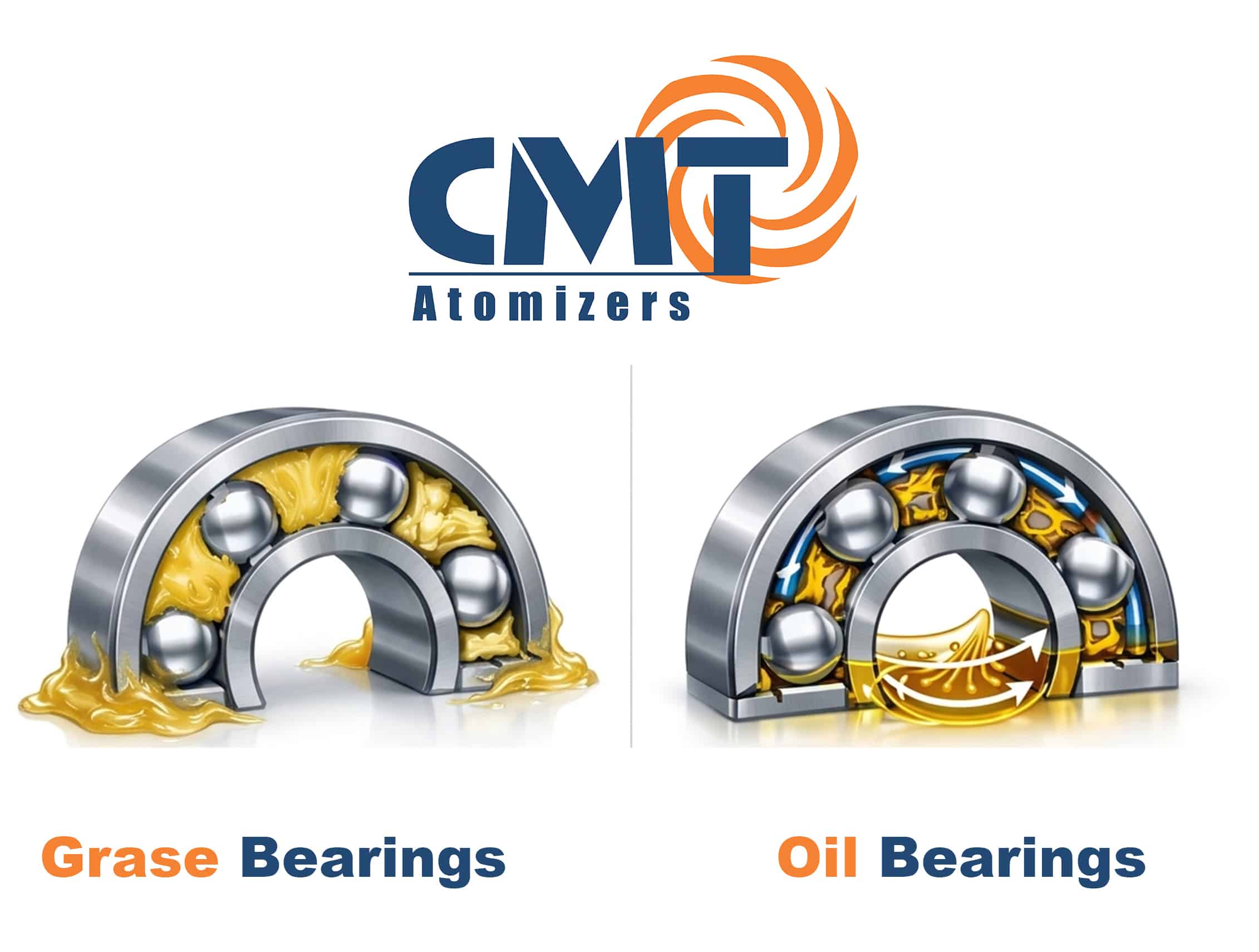
In spray drying, the rotary atomizer works under continuous stress: high speed, high load, and tight process windows. That is why atomizer lubrication directly affects uptime, temperature stability, wear, and – in regulated environments – contamination risk management.
When comparing oil atomizers and oil-free atomizers, the goal is not to pick a “best” option in general, but to match the lubrication strategy to your operating profile (duty cycle, temperature, environment) and to your industry constraints (e.g., hygiene or compliance).
At high rotational speeds, friction generates heat and accelerates wear if surfaces are not consistently separated by a stable lubricant film. Over time, this can translate into vibration, efficiency loss, and unplanned stops.
Thus, lubrication in atomizers plays a dual role: it reduces friction and can support heat dissipation lubrication – either by carrying heat away from friction zones (typical of oil systems) or by maintaining a protective layer where the load is concentrated (typical of grease-based systems).
At a high level, industrial atomizer lubrication follows two main approaches:
Oil lubrication uses a fluid lubricant that forms a thin film between moving parts. Because oil flows, it can spread through the lubrication path and help remove heat from friction zones, supporting temperature stability in demanding duty cycles.
Oil-lubricated atomizers are typically a strong fit when:
Key advantages
Potential limitations
Oil-free atomizers commonly rely on grease lubrication. Grease has higher viscosity and remains localized, which helps keep the lubricant where it is needed and reduces the tendency to migrate outside the lubrication zone.
This approach is often selected when containment is a priority and oil circulation is undesirable.
Oil-free (grease-lubricated) atomizers are typically indicated when:
Key advantages
Potential limitations
If strict contamination control is part of your requirements, explore CMT’s oil-free atomizers range to identify the most suitable configuration.
To select between oil lubrication and grease-based oil-free solutions, focus on these variables:
For application-specific guidance, reach out via our CMT contact page. Sharing your operating conditions (speed, temperature profile, duty cycle, product/industry constraints) is the fastest way to identify the best-fit lubrication approach.
A side-by-side summary is provided below.
| Feature | Oil lubrication | Grease lubrication (oil-free) |
| Viscosity and fluidity | Low viscosity, high fluidity | High viscosity, low fluidity |
| Lubricant distribution | Flows and reaches hard-to-access areas | Stays localized in contact zones |
| Cooling | Better heat dissipation | Limited cooling capacity |
| Contamination and leakage | May leak if not properly contained | Tends to stay in place; lower migration risk |
| Maintenance | Requires oil checks and, where applicable, recirculation (and filtration) | Typically longer maintenance intervals |
| Typical applications | Chemical, Ceramic, FGC | Food, Pharma, Flavors, Dairy |
